Deep Dive
The Full Science of
Multi-Layer Hydration
The Skin Barrier: Your First Defense
The skin is comprised of multiple distinct layers, each with different cellular densities, lipid compositions, and hydration requirements. The outermost layer — the stratum corneum — acts as a physical and chemical barrier against environmental aggressors. Below it, the viable epidermis contains actively dividing keratinocytes, and deeper still, the dermis houses the collagen matrix, elastin fibers, and fibroblasts that give skin its structural integrity.
Maintaining adequate hydration at each of these levels is not merely cosmetic — it is essential for proper cellular function, barrier repair, and the prevention of transepidermal water loss (TEWL), the process by which moisture escapes through the skin.
The Size Problem: Why Most Serums Fall Short
The human skin's protective barrier is remarkably efficient at keeping things out — including many skincare ingredients. The primary determinant of how deeply a hyaluronic acid molecule can penetrate is its molecular weight (MW), measured in kilodaltons (kDa). Studies indicate that molecules above approximately 500 kDa are largely unable to penetrate beyond the stratum corneum.
Standard sodium hyaluronate used in most skincare products has a molecular weight between 1,000–1,500 kDa. While highly effective at surface hydration and forming a moisture-retaining film, these large molecules cannot reach the living epidermis or dermis where structural hydration is most impactful.
"Enzymatic hydrolysis of high-molecular-weight hyaluronic acid to produce fragments of 50 kDa and below significantly enhances transdermal absorption and the biological activity within the viable epidermis." — International Journal of Cosmetic Science
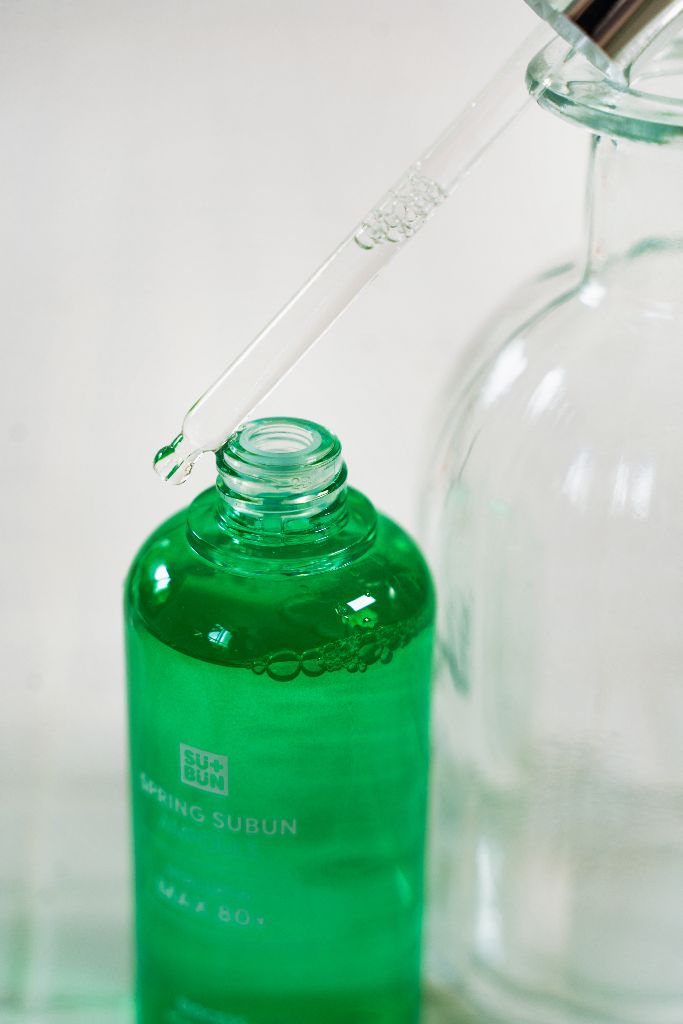
Spring Subun Ampoule's Five-Point Solution
The BIOCESS approach is to deploy five distinct molecular weights simultaneously, ensuring every layer of skin receives targeted hydration:
- Nano HA (~5 kDa) — The smallest molecules, capable of reaching the deep dermis to directly support collagen-producing fibroblasts and provide structural moisture from the inside out.
- Hydrolyzed HA (50–150 kDa) — Enzymatically broken-down chains that penetrate to the epidermal-dermal junction, where they visibly reduce the depth of fine lines and wrinkles.
- Medium-MW Sodium Hyaluronate (300–500 kDa) — Works in the living epidermis to reinforce the skin's natural moisture-retention mechanisms and strengthen the barrier function.
- HA Crosspolymer (800 kDa–1 MDa) — A specially cross-linked form that creates a sustained-release moisture reservoir in the upper epidermis, delivering continuous hydration throughout the day.
- Acetyl Glucosamine (>1 MDa) — The largest molecule, functioning as an HA precursor and surface film-forming agent, providing the iconic dewy finish while sealing all underlying hydration layers in place.
The Synergy Principle
The true innovation of multi-weight HA is not simply the individual molecules — it is their synergistic interaction. Nano-HA stimulates deeper hydration that draws additional moisture upward. High-MW HA on the surface prevents transepidermal water loss, creating a gradient that actually enhances the effectiveness of the deeper layers. The result is a self-reinforcing hydration system — what BIOCESS refers to as the Complete Hydration Loop.
Clinical studies on multi-weight HA complexes consistently show 40–80% greater improvement in skin hydration measurements compared to single-weight formulations, with particularly marked benefits in reduction of fine lines, improvement of skin elasticity, and long-term moisture retention over 8–12 weeks of use.
The Supporting Cast: Active Synergists
Spring Subun Ampoule doesn't rely on HA alone. Five additional key actives were selected for their scientifically validated synergy with multi-weight HA — each targeting a specific dimension of skin health:
- Tremella Fuciformis (Snow Mushroom) Extract — Often called "nature's hyaluronic acid," Tremella polysaccharides form nano-sized spherical structures that closely mimic the skin's own moisturizing factors. Unlike HA, Tremella's smaller particle size allows it to penetrate the skin's surface more readily, while its complex branching structure holds an exceptional quantity of water — in some studies, outperforming HA itself in sustained moisture retention.
- Baicalin — A flavonoid glycoside isolated from the root of Scutellaria baicalensis (Chinese skullcap), a plant used in traditional Korean and Chinese medicine for centuries. Baicalin exhibits potent antioxidant activity, neutralizing reactive oxygen species (ROS) generated by UV exposure and pollution. It also suppresses inflammatory cytokines, protecting the skin's collagen matrix from oxidative degradation.
- Wild Yam Extract (Dioscorea Japonica) — Derived from the root of the Japanese wild yam, rich in diosgenin and saponin compounds that exert a calming, anti-irritant effect on sensitized skin. Particularly valuable for restoring comfort to reactive skin types, Wild Yam Extract works alongside the HA complex to ensure the hydration delivery system is tolerated by even the most sensitive skin.
- Panthenol (Pro-Vitamin B5) — Converts to pantothenic acid upon absorption, a compound integral to the skin's own repair mechanisms. Panthenol stimulates fibroblast proliferation, accelerates barrier recovery after disruption, and enhances the cohesion of the stratum corneum — effectively strengthening the same outer layer that the HA complex is designed to hydrate and protect.
- Allantoin — A natural keratolytic and anti-irritant that promotes the gentle shedding of dead surface cells, allowing the HA molecules to penetrate more efficiently. Allantoin also stimulates keratinocyte proliferation, supporting the skin's continuous self-renewal cycle for a smoother, more even texture over time.
Together, these actives address hydration, antioxidant protection, skin-calming, barrier reinforcement, and cellular renewal — the five pillars that define truly healthy, resilient skin.